Listen to this article
NFA vs DFA Explained Simply (With Examples That Actually Make Sense)
Introduction
If you are learning automata theory, one of the first confusing topics you will face is NFA vs DFA.
Most students memorize definitions but still struggle to actually understand the difference.
The truth is, the concept is not difficult. It just needs to be explained in a practical and simple way.
This guide will help you understand NFA and DFA clearly, with real examples and easy explanations.
Why Students Get Confused
The confusion usually comes from:
- Complex textbook definitions
- Lack of real examples
- Too much focus on theory
- Not understanding how transitions actually work
As a result, students remember terms but fail to apply them.

What Is DFA (Deterministic Finite Automaton)
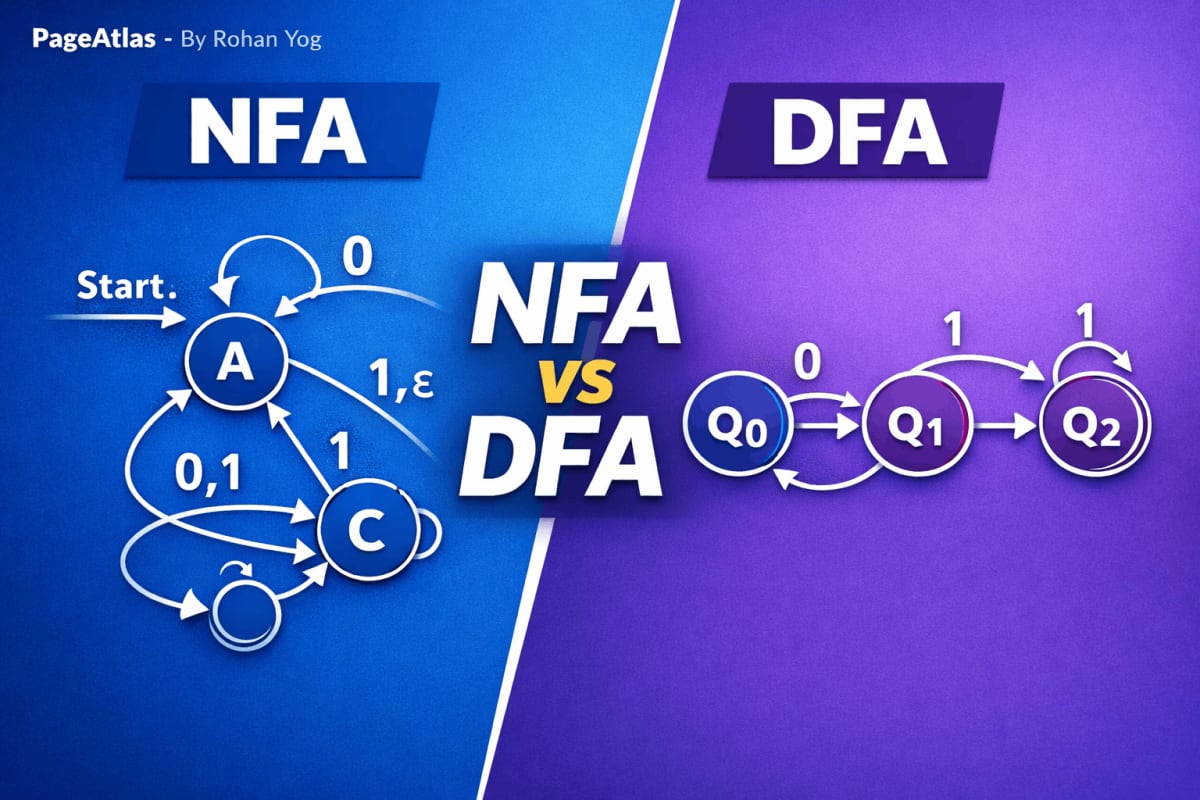
DFA is a machine where:
- For every state and input, there is exactly one next state
- There is no confusion or multiple paths
- The output is always predictable
In simple words, DFA follows a single clear path.
What Is NFA (Non-Deterministic Finite Automaton)
NFA is different because:
- A state can have multiple possible next states
- It can even move without input (epsilon transitions)
- It explores multiple paths at once
In simple terms, NFA can “guess” the correct path.
Key Difference in Simple Language
Instead of memorizing definitions, understand it like this:
- DFA = one path, fixed decision
- NFA = multiple paths, flexible decision
DFA is strict, NFA is flexible.
Example That Makes Everything Clear
Imagine a system that checks if a string contains “ab”.
DFA approach:
It will follow one fixed path step by step:
- Read ‘a’ → move to next state
- Read ‘b’ → accept
If input does not match, it rejects immediately.
NFA approach:
It can:
- Stay in current state
- Move to another state
- Try multiple possibilities
Even if one path fails, another path might accept the string.
Transition Difference Explained
In DFA:
- One input → one transition
In NFA:
- One input → multiple transitions possible
This is the core difference.
Why NFA Feels Easier but DFA Is Used More
NFA is easier to design because:
- You can define multiple possibilities
- Less strict structure
But DFA is used in real systems because:
- It is predictable
- Easy to implement
- Faster for execution
Step-by-Step Understanding Using a Small Example
Let us take a simple language:
Strings ending with “01”
DFA Thinking:
You create clear states:
- Start
- Seen ‘0’
- Seen ‘01’ (final state)
Each input leads to exactly one state.
NFA Thinking:
You allow:
- Multiple transitions
- Flexible movement
- Possible shortcuts
This makes design easier but execution complex.
NFA to DFA Conversion (Important Concept)
Even though NFA and DFA look different, they are equivalent.
This means:
Every NFA can be converted into a DFA.
This is done using subset construction.
Basic idea:
- Combine multiple NFA states into one DFA state
Practical Use Cases
DFA is used in:
- Compilers
- Pattern matching
- Lexical analysis
NFA is used in:
- Designing logic
- Simplifying automata problems
- Initial modeling
Real-Life Analogy
Think of DFA as:
A train running on a fixed track
It cannot change direction
Think of NFA as:
A person exploring multiple paths in a maze
Trying different routes at once
Common Mistakes to Avoid
- Thinking NFA is more powerful than DFA
- Ignoring epsilon transitions
- Confusing multiple transitions with randomness
- Memorizing definitions without understanding
Pro Tips for Exams and Interviews
- Always draw diagrams
- Focus on transitions, not definitions
- Practice conversion problems
- Understand concept before memorizing
Quick Summary in Simple Words
- DFA has one path
- NFA can have many paths
- Both recognize the same languages
- DFA is used in real-world systems
Conclusion
NFA vs DFA is not about difficulty. It is about understanding how decisions are made.
Once you visualize transitions and paths, the concept becomes clear.
Focus on examples, practice regularly, and avoid overcomplicating the theory.
That is the simplest way to master automata concepts.
FAQ
1. What is the main difference between NFA and DFA?
DFA has one transition per input, while NFA can have multiple.
2. Is NFA more powerful than DFA?
No, both are equivalent in power.
3. Why is DFA preferred in real applications?
Because it is deterministic and easier to implement.
4. Can every NFA be converted to DFA?
Yes, using subset construction.
5. Which is easier to understand?
NFA is easier to design, DFA is easier to execute.

Rohan Yog
Rohan Yog is a software developer and digital creator focused on building practical solutions and sharing knowledge about AI, blogging, and online income. Through PageAtlas, he helps beginners learn modern tools and turn their skills into real-world results.
View all articles by Rohan Yog→