Listen to this article
Mealy vs Moore Machine Explained Simply (With Real Examples That Actually Make Sense)
Introduction
If you have ever studied automata theory, you have probably faced this situation.
You understand DFA, you understand NFA, but when it comes to Mealy and Moore machines, things suddenly feel confusing.
Both look similar. Both use states. Both deal with input and output. Yet exam questions keep testing the difference between them, and many students still get stuck.
The truth is, this topic is not difficult at all. It is just explained in a way that makes it look complex.
Once you understand one simple idea—how output is generated—everything becomes clear.
In this guide, you will learn Mealy and Moore machines in a very practical way, using simple language, real examples, and step-by-step thinking.

The Real Problem Most Students Face
Let’s be honest.
Most students try to memorize definitions like:
- “Mealy machine output depends on state and input”
- “Moore machine output depends only on state”
But when asked to:
- draw diagrams
- solve problems
- convert machines
they struggle.
Why?
Because memorization is not understanding.
The real problem is that students are not shown how these machines behave in real situations.
So instead of memorizing, we will understand how they actually work.
First, Understand What These Machines Are
Before comparing them, you need to understand one basic thing.
Both Mealy and Moore machines are finite automata with output.
That means:
- They take input
- They move between states
- They produce output
The only difference is when and how the output is generated.
Understanding Mealy Machine in the Simplest Way
A Mealy machine produces output based on:
- current state
- current input
In simple words:
The moment input comes, output is generated immediately.
You can think of it like a system that reacts instantly.
Real-Life Analogy for Mealy Machine
Imagine a light switch:
- You press the switch → light turns ON immediately
- You press again → light turns OFF
There is no delay. The output depends directly on your action.
That is exactly how a Mealy machine behaves.
Simple Example of Mealy Machine
Let’s take a basic problem:
“Output 1 whenever input is 1”
Input:
0 1 0 1
Output:
0 1 0 1
Here:
- Input directly controls output
- No waiting
- No delay
This is Mealy behavior.
Understanding Moore Machine in the Simplest Way
A Moore machine produces output based only on:
- current state
Input does not directly decide output.
Instead, input changes the state, and then the state produces output.
Real-Life Analogy for Moore Machine
Think of a traffic light:
- Light stays RED
- Only after a timer changes state → it becomes GREEN
The output (light color) depends on the state, not directly on input.
Simple Example of Moore Machine
Same problem:
“Output 1 when condition is met”
But now:
- Output is tied to state
- Even if input changes, output updates only after state changes
This creates a slight delay.
The One Line That Makes Everything Clear
If you remember nothing else, remember this:
- Mealy → Output depends on input + state
- Moore → Output depends only on state
That is the entire difference.
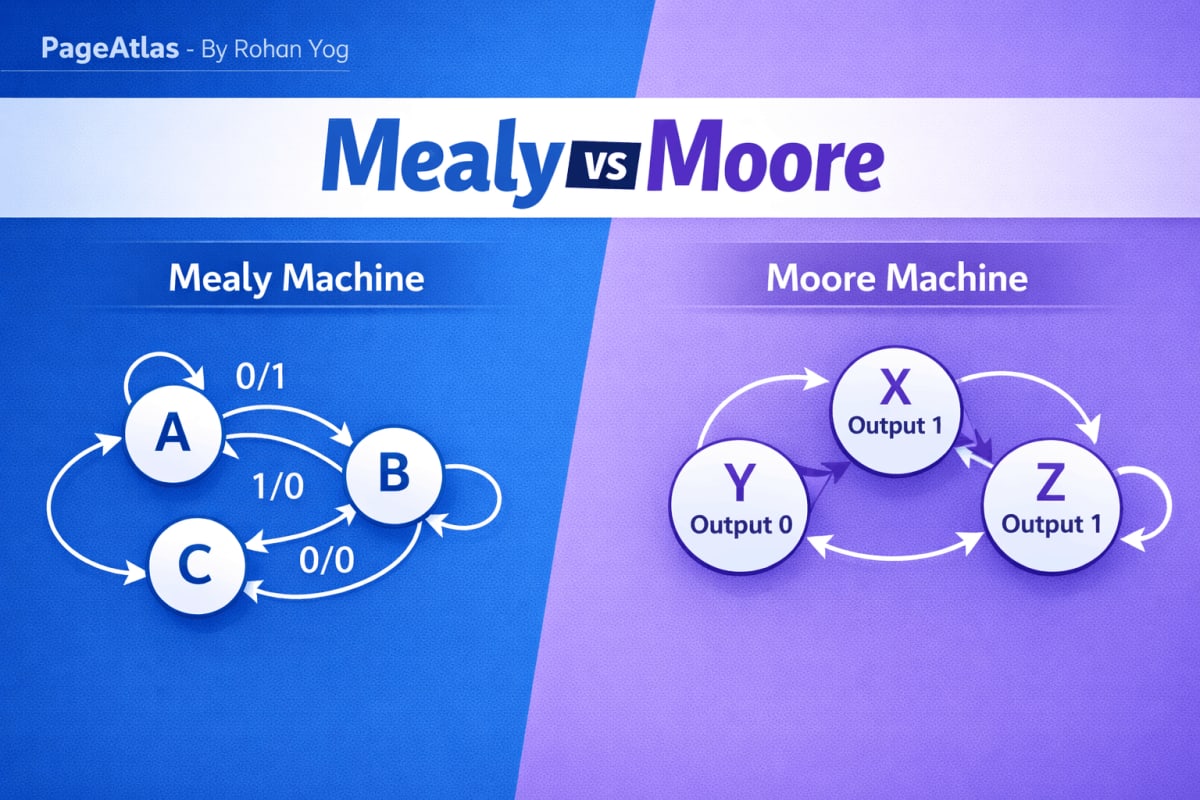
Visual Understanding (Most Important)
Let’s make it even clearer.
In Mealy machine:
- Output is written on transitions (edges)
In Moore machine:
- Output is written inside states (nodes)
This is why:
- Mealy reacts faster
- Moore is more stable
Step-by-Step Comparison Using One Example
Let’s take a real problem:
“Detect sequence 01”
Mealy Machine Thinking
- Read input
- As soon as “01” appears → output = 1
Immediate reaction.
Moore Machine Thinking
- Move through states
- Output changes only after reaching a state
So output comes slightly later.
Why Mealy Machine Uses Fewer States
Because output depends on input.
You do not need extra states to handle output variations.
This makes Mealy machine:
- more compact
- easier to design
Why Moore Machine Uses More States
Because output depends only on state.
So each output variation needs its own state.
This increases:
- number of states
- complexity
Practical Example (Very Important)
Let’s build a simple system:
“Output 1 when input sequence ends with 1”
Mealy Machine Design Idea
- If input = 1 → output = 1
- If input = 0 → output = 0
Simple and direct.
Moore Machine Design Idea
- Create state where output = 1
- Move to that state when input = 1
Here:
- Output changes after state change
- Not immediately
Where Mealy Machine Is Used
Mealy machines are useful when:
- Fast response is needed
- Output must change instantly
- System reacts directly to input
Examples:
- digital circuits
- real-time systems
Where Moore Machine Is Used
Moore machines are useful when:
- stability is important
- output should not fluctuate quickly
- predictable behavior is needed
Examples:
- control systems
- hardware design
Conversion Between Mealy and Moore
This is a common exam topic.
Mealy to Moore
- Increase number of states
- Separate outputs into states
Moore to Mealy
- Reduce states
- Move output to transitions
Step-by-Step Learning Approach
If you want to master this topic:
Step 1:
Understand output dependency
Step 2:
Practice small examples
Step 3:
Draw diagrams
Step 4:
Solve conversion problems
Example Prompts to Practice with AI
“Explain mealy machine with real example”
“Convert mealy machine to moore step by step”
“Give solved example of moore machine”
“Difference between mealy and moore with diagram”
Common Mistakes Students Make
- Mixing up output rules
- Forgetting delay in Moore machine
- Drawing incorrect transitions
- Not practicing enough examples
Pro Tips for Exams and Interviews
- Always check output dependency first
- Use diagrams for clarity
- Keep answers simple
- Practice conversions
Quick Revision Section
- Mealy → faster, fewer states
- Moore → stable, more states
- Mealy output = state + input
- Moore output = state only
Why This Topic Matters
This concept is not just for exams.
It helps you understand:
- how systems generate output
- how machines respond to input
- how real-world systems are designed
It builds a strong foundation for:
- compiler design
- digital electronics
- system design
Conclusion
Mealy and Moore machines are not difficult concepts.
They only appear confusing because of the way they are taught.
Once you understand how output is generated, everything becomes clear.
Focus on logic, not memorization.
Practice a few examples, and you will be able to solve any question related to this topic with confidence.
FAQ
1. What is the main difference between Mealy and Moore machine?
Mealy output depends on input and state, Moore depends only on state.
2. Which machine is faster?
Mealy machine is faster.
3. Which is easier to design?
Mealy is simpler with fewer states.
4. Why Moore machine uses more states?
Because output depends only on states.
5. Can they be converted?
Yes, both can be converted into each other.

Rohan Yog
Rohan Yog is a software developer and digital creator focused on building practical solutions and sharing knowledge about AI, blogging, and online income. Through PageAtlas, he helps beginners learn modern tools and turn their skills into real-world results.
View all articles by Rohan Yog→