
Listen to this article
Neural Networks Explained Simply (With Real-Life Example That Makes It Click)
If you’ve ever wondered how apps recognize your face, recommend videos, or understand your voice, you’re already interacting with neural networks.
The problem is — most explanations make neural networks sound complicated.
But in reality, the idea is surprisingly simple.
Once you understand the core concept, everything starts to make sense.
What is a Neural Network?
A neural network is a system designed to mimic how the human brain works.
It learns from data and makes decisions or predictions.
In simple words:
A neural network = a system that learns patterns and gives outputs.

Real-Life Example (Best Way to Understand)
Imagine you want to identify whether an image contains a cat.
Instead of writing rules like:
- Has ears
- Has whiskers
A neural network learns automatically.
You give it:
- Thousands of cat images
- Thousands of non-cat images
Over time, it learns patterns and becomes good at predicting.
Why Do We Need Neural Networks?
Traditional programming:
- You write rules
Neural networks:
- They learn rules
This is powerful because:
- Real-world problems are complex
- Rules are not always clear
How Neural Networks Work (Step-by-Step)
Let’s simplify the process.
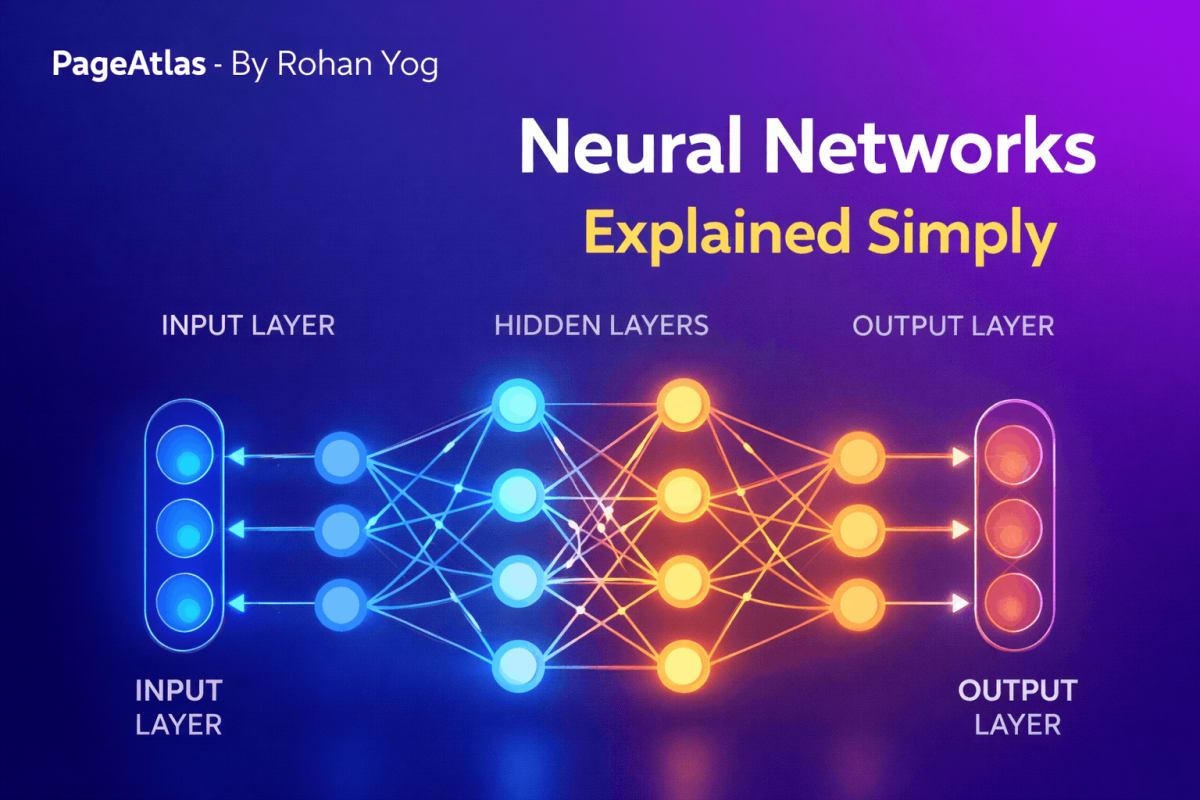
Step 1: Input Layer
This is where data enters.
Example:
- Image pixels
- Numbers
- Text
Step 2: Hidden Layers
This is where learning happens.
- Each layer extracts features
- Data is processed step by step
Step 3: Output Layer
Final result is produced.
Example:
- Cat or not cat
- Spam or not spam
Simple Flow
Input → Processing → Output
That’s the entire idea.
What Happens Inside a Neural Network?
Each neuron:
- Receives input
- Applies a weight
- Passes output forward
It’s like:
Each neuron makes a small decision.
Together:
They form a powerful system.
Example (Easy Understanding)
Let’s say you want to predict if a student will pass.
Inputs:
- Study hours
- Attendance
- Previous marks
Neural network learns patterns:
- High study hours → more chance of passing
Key Concepts (Simplified)
Weights
Importance of each input.
Example:
Study hours may matter more than attendance.
Activation Function
Decides whether a neuron should activate.
Training
The process of learning from data.
Loss Function
Measures error.
Backpropagation
Improves the model by reducing error.
Types of Neural Networks
1. Feedforward Neural Network
Basic type where data moves forward.
2. Convolutional Neural Network (CNN)
Used for images.
3. Recurrent Neural Network (RNN)
Used for sequences like text.
Neural Network vs Traditional Programming
Traditional:
Input + Rules → Output
Neural Network:
Input + Output → Learns Rules
Where Are Neural Networks Used?
They are everywhere:
- Face recognition
- Voice assistants
- Chatbots
- Recommendation systems
- Self-driving cars
Real-World Applications
1. YouTube Recommendations
Suggests videos based on behavior.
2. Google Translate
Converts languages using neural networks.
3. Self-Driving Cars
Detects objects and makes decisions.
4. Medical Diagnosis
Helps detect diseases.
Step-by-Step Learning Path (Actionable)
If you want to learn neural networks:
Step 1:
Understand basics of machine learning
Step 2:
Learn simple neural networks
Step 3:
Practice with small datasets
Step 4:
Move to deep learning
Pro Tips (Very Important)
1. Focus on Intuition First
Don’t jump into math immediately.
2. Practice with Examples
Small projects help a lot.
3. Visualize Learning
Use diagrams to understand flow.
4. Learn by Building
Try simple models.
Common Mistakes
Mistake 1: Jumping Directly to Code
Understand concept first.
Mistake 2: Ignoring Basics
Neural networks depend on fundamentals.
Mistake 3: Overcomplicating Things
Keep it simple.
Mistake 4: Not Practicing
Theory alone is not enough.
Why Neural Networks Feel Hard (But Aren’t)
They feel hard because:
- Too many terms
- Mathematical background
But at core:
It’s just pattern recognition.
Advanced Insight (To Stand Out)
To go deeper:
- Learn deep learning
- Understand optimization
- Explore frameworks like TensorFlow
Final Thoughts
Neural networks are not magic.
They are systems that learn patterns from data.
Once you understand this idea, everything becomes easier.
FAQ
Q1: What is a neural network in simple words?
It is a system that learns patterns from data and makes predictions.
Q2: Where are neural networks used?
In AI systems like face recognition, chatbots, and recommendations.
Q3: Are neural networks hard to learn?
Not if you focus on basic concepts first.
Q4: What is difference between AI and neural networks?
Neural networks are a part of AI.
Q5: How to start learning neural networks?
Start with basics of machine learning and practice simple models.

Rohan Yog
Rohan Yog is a software developer and digital creator focused on building practical solutions and sharing knowledge about AI, blogging, and online income. Through PageAtlas, he helps beginners learn modern tools and turn their skills into real-world results.
View all articles by Rohan Yog→