Listen to this article
Chomsky Hierarchy Explained in the Simplest Way (With Real Examples)
Introduction
If you have ever studied automata theory, you have probably come across the term “Chomsky Hierarchy” and felt completely confused.
Most explanations are full of complex definitions, symbols, and theory that make it harder to understand.
But the concept itself is actually very simple.
This guide will break down the Chomsky Hierarchy in the easiest possible way so that you can understand it clearly and remember it for exams and interviews.

Why Most Students Struggle with Chomsky Hierarchy
The main problem is not the topic, but how it is taught.
Students usually face:
- Heavy theoretical definitions
- No real-life examples
- Confusing grammar rules
- Memorization instead of understanding
Because of this, many students remember “Type 0, 1, 2, 3” but do not know what they actually mean.
The Basic Idea of Chomsky Hierarchy
Chomsky Hierarchy is a way to classify different types of grammars and languages.
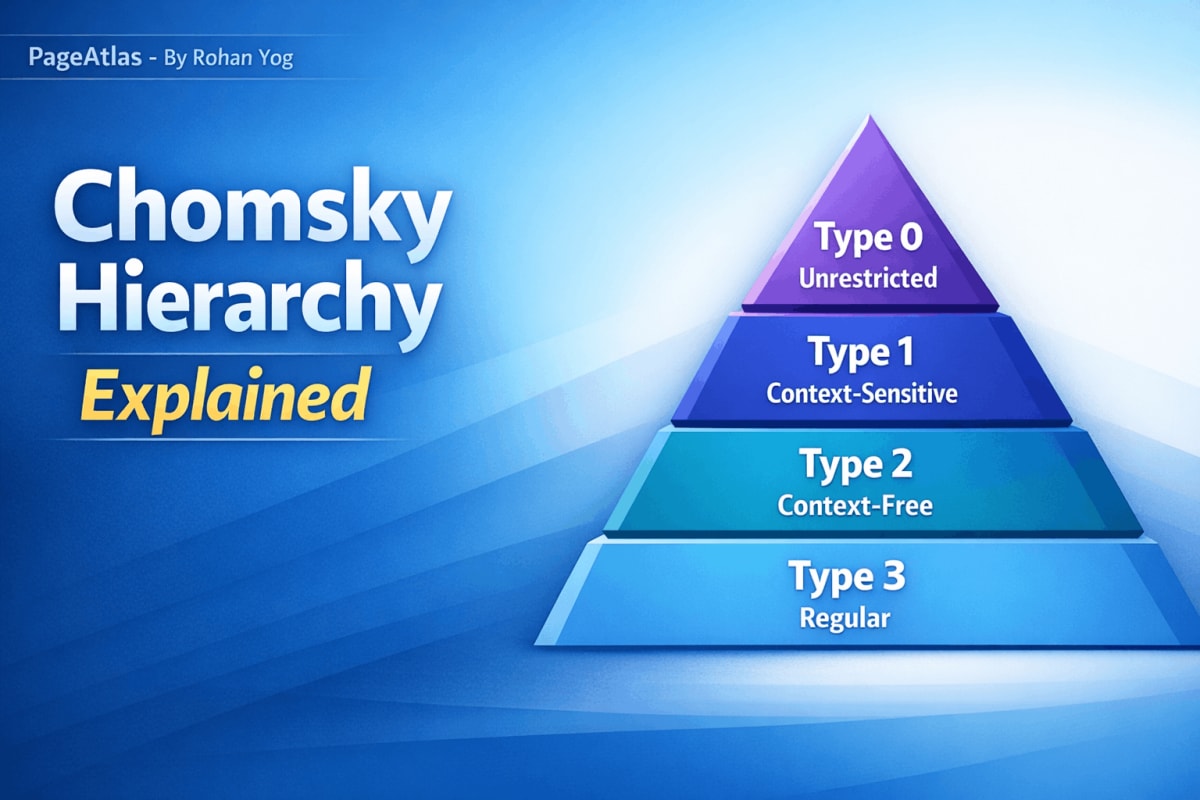
It divides them into four levels:
- Type 0 (Unrestricted Grammar)
- Type 1 (Context-Sensitive Grammar)
- Type 2 (Context-Free Grammar)
- Type 3 (Regular Grammar)
The important idea is:
As you go from Type 3 to Type 0, the power increases, but complexity also increases.
The Simplest Way to Understand It
Think of it like rules for generating sentences.
- Some rules are very simple
- Some rules are flexible
- Some rules are very powerful
Chomsky Hierarchy organizes these rules from simplest to most complex.
Type 3: Regular Grammar (Easiest)
This is the simplest type.
Rules are very basic and predictable.
Example:
Strings like:
- “a”
- “ab”
- “aaa”
These follow simple patterns.
Used in:
- Pattern matching
- Lexical analysis
Real-life example:
Checking if a string contains only digits.
Type 2: Context-Free Grammar
This is more flexible than regular grammar.
It allows nested structures.
Example:
Balanced parentheses:
- ()
- (())
- (()())
This cannot be handled by simple rules.
Used in:
- Programming languages
- Syntax parsing
Real-life example:
Checking if brackets in code are balanced.
Type 1: Context-Sensitive Grammar
This type depends on context.
Rules change depending on surrounding symbols.
Example:
A rule may apply only if certain conditions are met.
Used in:
- Advanced language processing
Real-life example:
Grammar rules in natural languages where meaning depends on context.
Type 0: Unrestricted Grammar (Most Powerful)
This is the most flexible and powerful type.
There are almost no restrictions.
It can represent any computation.
Used in:
- Theoretical computer science
Real-life example:
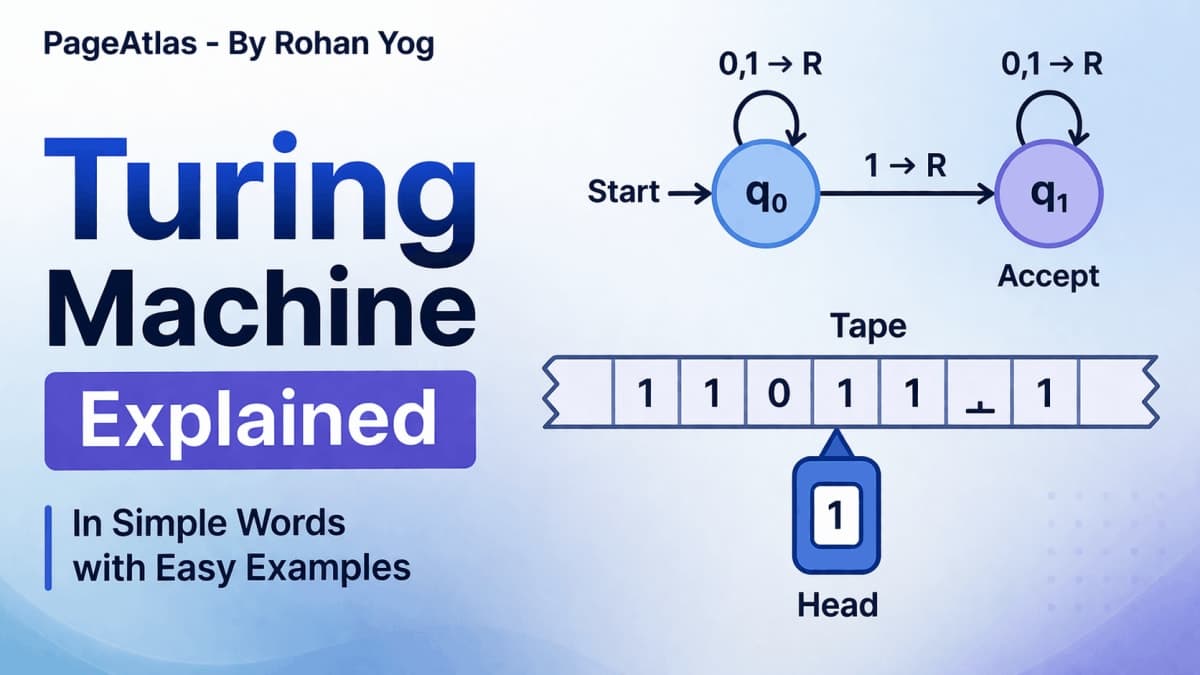
General computation systems like Turing machines.
Simple Comparison to Remember Easily
Instead of memorizing, remember this:
- Type 3 → simplest, fixed patterns
- Type 2 → handles nested structures
- Type 1 → depends on context
- Type 0 → no restrictions
Real Example That Connects Everything
Let us take a simple idea: validating expressions.
- Regular grammar → checks simple patterns
- Context-free → checks balanced brackets
- Context-sensitive → checks variable usage rules
- Unrestricted → handles full computation
This shows how complexity increases step by step.
Step-by-Step Way to Understand and Remember
Step 1:
Start with regular grammar (Type 3)
Step 2:
Understand nested structures (Type 2)
Step 3:
Learn context dependency (Type 1)
Step 4:
Understand full power (Type 0)
Do not try to learn everything at once.
Example Prompts to Learn Faster Using AI
You can use prompts like:
“Explain Chomsky hierarchy in simple words with examples for each type”
“Give real-life examples of context-free grammar”
“Compare regular grammar and context-free grammar with examples”
“Explain Type 1 grammar with a simple example”
Pro Tips That Help in Exams
- Focus on examples, not definitions
- Understand differences between types
- Practice classification questions
- Remember the order: Type 3 → Type 2 → Type 1 → Type 0
Common Mistakes to Avoid
- Memorizing without understanding
- Confusing grammar types
- Ignoring examples
- Skipping basics
- Not practicing enough
Why Chomsky Hierarchy Is Important
It helps you understand:
- How programming languages work
- How compilers are designed
- How patterns and languages are recognized
It is a foundation for many computer science concepts.
Quick Revision Summary
- Type 3: simplest, regular patterns
- Type 2: nested structures
- Type 1: context-based rules
- Type 0: most powerful, no restrictions
Conclusion
Chomsky Hierarchy is not difficult when you understand it step by step.
The key is to focus on examples and real understanding instead of memorizing theory.
Once you grasp the basic idea, everything becomes much clearer.
If you revisit this topic after some practice, you will find it much easier than it seemed at first.
FAQ Section
1. What is Chomsky Hierarchy?
It is a classification of grammars into four types based on complexity.
2. Which is the simplest type?
Type 3 (Regular Grammar).
3. Which is the most powerful type?
Type 0 (Unrestricted Grammar).
4. Why is it important?
It helps in understanding programming languages and compilers.
5. Is it difficult to learn?
No, if explained with examples.

Rohan Yog
Rohan Yog is a software developer and digital creator focused on building practical solutions and sharing knowledge about AI, blogging, and online income. Through PageAtlas, he helps beginners learn modern tools and turn their skills into real-world results.
View all articles by Rohan Yog→