Listen to this article
NFA vs DFA: Definitions, Differences, Examples & Comparison
Finite Automata are fundamental concepts in Automata Theory and play a major role in areas like compiler design, pattern recognition, and lexical analysis. Among the different types of finite automata, the two most important models are Deterministic Finite Automata (DFA) and Nondeterministic Finite Automata (NFA).
Both models are used to recognize regular languages, but they differ in structure, flexibility, and implementation.
In this guide, we will explore NFA vs DFA, their definitions, key differences, examples, and real-world applications.
What is Finite Automata?
Finite Automata (FA) are abstract machines used to recognize patterns within input strings. They are widely used in computer science for tasks like:
- designing compilers
- text processing
- pattern matching
- lexical analysis
Finite automata consist of:
- a finite number of states
- an input alphabet
- transition functions
- a start state
- one or more accepting states
Two major types of finite automata are:
- Deterministic Finite Automata (DFA)
- Nondeterministic Finite Automata (NFA)
What is DFA (Deterministic Finite Automata)?
A Deterministic Finite Automaton (DFA) is a finite state machine where each state has exactly one transition for every input symbol.
This means that at any point during computation, the machine has only one possible next state.
Key Characteristics of DFA
- Exactly one transition for each input symbol
- No epsilon (ε) transitions allowed
- No ambiguity in state transitions
- Easier to implement in real systems
- May require more states compared to NFA
Example
If a DFA is in state q0 and reads input a, there will be only one possible next state.
Because of its deterministic behavior, DFA is widely used in lexical analyzers of compilers.
What is NFA (Nondeterministic Finite Automata)?
A Nondeterministic Finite Automaton (NFA) allows multiple possible transitions for the same input symbol.
This means that the machine may move to multiple states simultaneously for a given input.
Key Characteristics of NFA
- Multiple transitions allowed for the same input
- Supports epsilon (ε) transitions
- More flexible than DFA
- Easier to design complex automata
- Requires conversion to DFA for practical implementation
Example
From state q0, reading input a may lead to:
q1
q2
q3
If any computation path reaches an accepting state, the input is accepted.
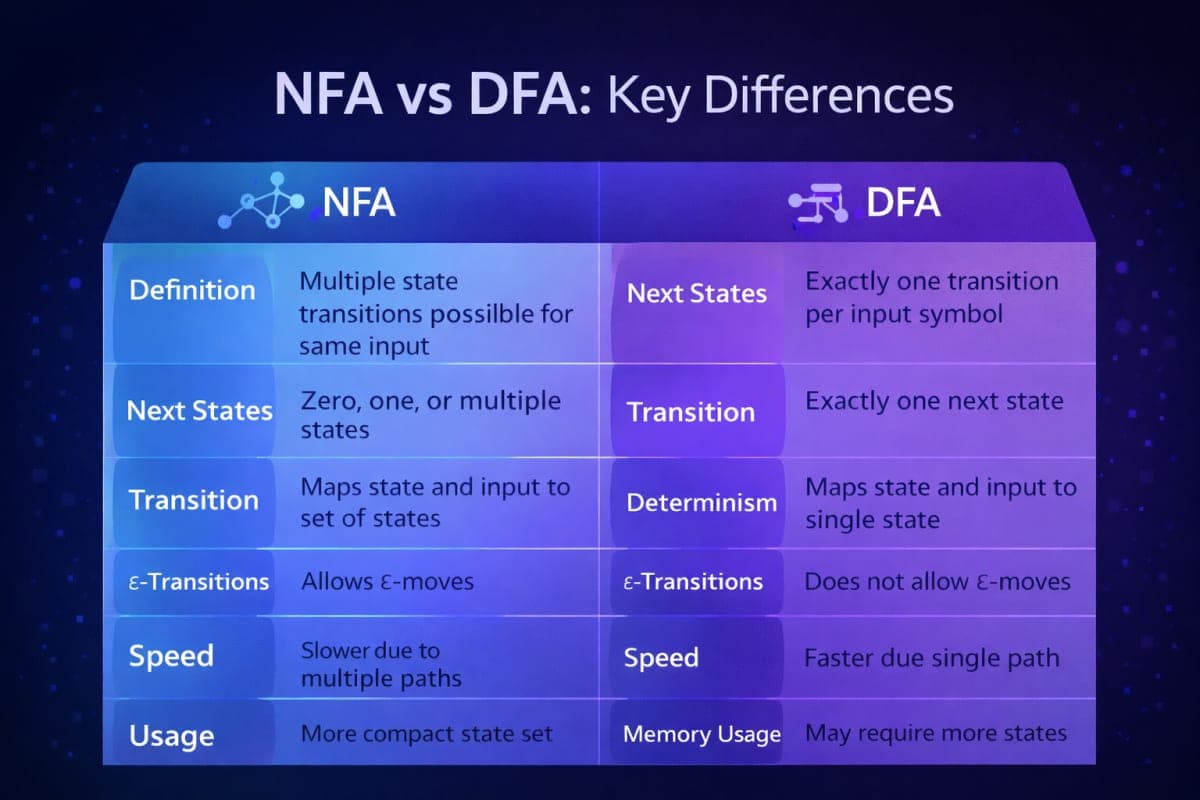
DFA vs NFA Comparison Table
DFA
- Exactly one transition per input symbol
- No ε-transitions
- Faster execution because only one path is followed
- Easier to implement but may require more states
NFA
- Multiple transitions possible for the same input symbol
- Allows ε-transitions
- More flexible and compact
- May require extra processing during conversion to DFA
Differences Between DFA and NFA
The major differences between DFA and NFA include:
1. Transition Behavior
A DFA allows only one transition per input symbol, while an NFA can have multiple transitions.
2. Epsilon Transitions
DFA does not allow ε-transitions, but NFA allows them.
3. Implementation
DFA is easier to implement in real-world applications, while NFA is easier to design.
4. Memory Requirements
DFA may require more states, while NFA often uses fewer states.
5. Execution Speed
DFA processes input faster because it follows a single computation path, whereas NFA may explore multiple paths.
Can NFA Be Converted to DFA?
Yes. Every NFA can be converted into an equivalent DFA using a technique called the Subset Construction Method.
This conversion ensures that both machines recognize the same language, even though their structures may differ.
Real-World Applications
Both DFA and NFA are widely used in computer science applications.
ModelApplicationsDFALexical analyzers, compiler design, pattern recognitionNFARegular expression engines, theoretical language models
For example, regular expression engines often convert NFA into DFA internally to improve performance.
Which One is Better: DFA or NFA?
Neither DFA nor NFA is universally better; each has its advantages.
- DFA is preferred for implementation and execution efficiency.
- NFA is useful when designing complex automata with fewer states.
In practice, many systems design NFAs first and then convert them into DFAs.
Conclusion
Understanding the difference between DFA and NFA is essential for students studying Automata Theory, compiler design, and formal language processing.
While DFA provides deterministic and fast execution, NFA offers flexibility and easier design. Despite their differences, both models are equivalent in power and can recognize the same set of regular languages.
Learning how these automata work helps build a strong foundation in computer science and language processing systems.
Author: Rohan Yog
Website: PageAtlas

Rohan Yog
Experienced writer and tech enthusiast. Follow for more insightful articles on technology, programming, and web development.
View all articles by Rohan Yog→