Listen to this article
Chomsky Classification Explained: Types of Grammars in Automata Theory
Understanding how languages are structured is one of the most important concepts in Automata Theory and compiler design. One of the foundational models used to classify languages is the Chomsky Hierarchy, introduced by Noam Chomsky in 1956.
The Chomsky Hierarchy categorizes formal grammars into different levels based on their generative power and complexity. This classification helps computer scientists understand what types of languages machines can recognize and how different computational models process them.
In this article, we will explore the Chomsky Classification, its four types of grammars, and their real-world applications.
What is Chomsky Classification?
The Chomsky Hierarchy is a theoretical framework that divides formal languages into four categories based on the complexity of their grammar rules.
Each grammar type corresponds to a specific computational model capable of recognizing that language.
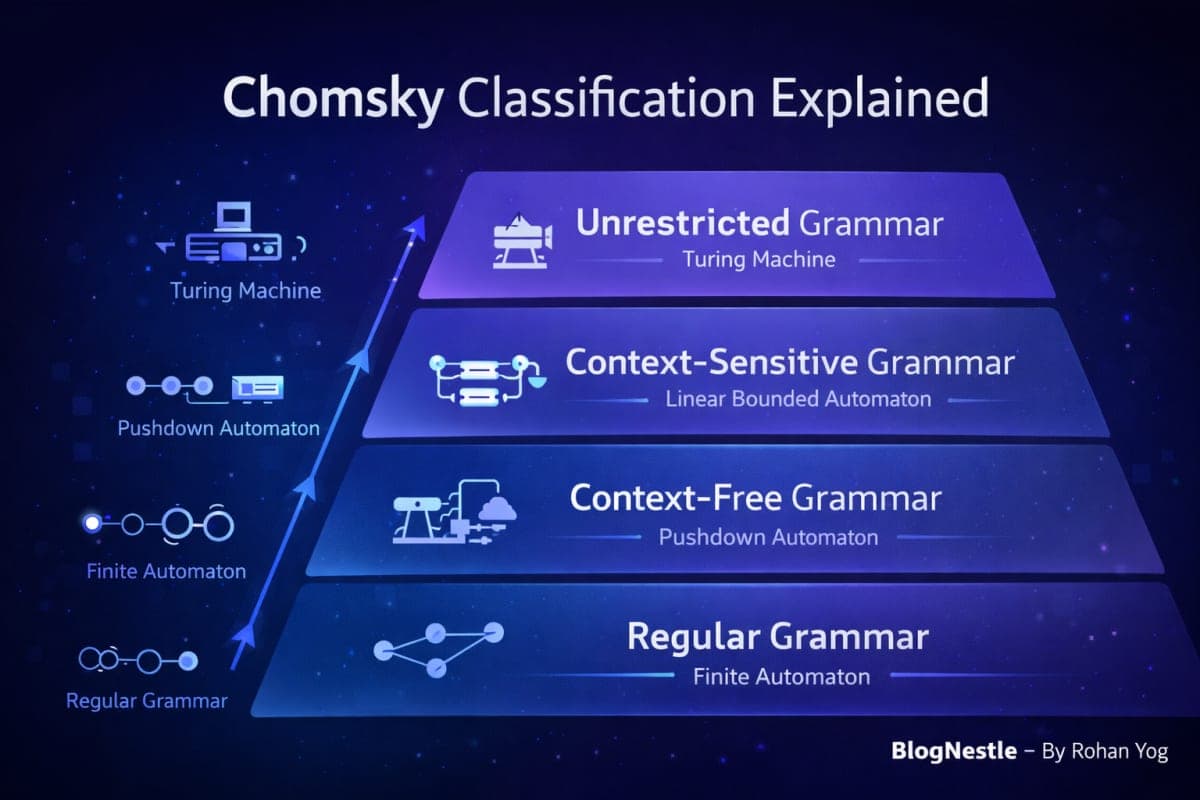
The four types of grammars are:
TypeGrammar TypeLanguage ClassRecognized ByType 0Unrestricted GrammarRecursively EnumerableTuring MachineType 1Context-Sensitive GrammarCSLLinear Bounded AutomatonType 2Context-Free GrammarCFLPushdown AutomatonType 3Regular GrammarRLFinite Automaton
These grammar classes form a hierarchy, meaning higher levels are more powerful and capable of describing more complex languages.
Type 0: Unrestricted Grammar
Unrestricted Grammar is the most powerful grammar type in the Chomsky hierarchy.
Production Rule
α → β
Where:
- α and β can contain any combination of terminals and non-terminals
- |α| ≥ 1
Recognized By
Turing Machines.
Example Language
{ aⁿbⁿcⁿ | n ≥ 1 }
Characteristics
- Can describe any computable language
- Highly flexible grammar rules
- Some problems involving these grammars are undecidable
Because of its complexity, unrestricted grammar is mostly used in theoretical computer science.
Type 1: Context-Sensitive Grammar (CSG)
Context-Sensitive Grammar is slightly less powerful than unrestricted grammar but still capable of representing complex languages.
Production Rule
αAβ → αγβ
Where:
- A is a non-terminal
- γ must contain at least one symbol
Recognized By
Linear Bounded Automaton (LBA).
Example Language
{ aⁿbⁿcⁿ | n ≥ 1 }
Characteristics
- Production rules depend on the context of symbols
- More restrictive than Type 0 grammars
- Often used in natural language processing
Type 2: Context-Free Grammar (CFG)
Context-Free Grammar is widely used in programming language design and compiler construction.
Production Rule
A → γ
Where:
- A is a single non-terminal
- γ can be terminals or non-terminals
Recognized By
Pushdown Automaton (PDA).
Example Language
{ aⁿbⁿ | n ≥ 0 }
Characteristics
- Easier to parse and implement
- Supports recursive structures
- Commonly used in syntax analysis for programming languages
Most programming languages rely on context-free grammars for defining syntax rules.
Type 3: Regular Grammar
Regular Grammar is the simplest and most restrictive grammar type.
Production Rule
A → aB
A → a
Recognized By
Finite Automaton (DFA or NFA).
Example Language
{ aⁿbᵐ | n, m ≥ 0 }
Characteristics
- Very efficient to process
- Used in pattern matching and lexical analysis
- Cannot handle nested structures such as balanced parentheses
Regular grammars form the basis for regular expressions and tokenizers.
Real-World Applications of Chomsky Hierarchy
The Chomsky classification has several practical uses in computer science.
Grammar TypeReal-World ApplicationType 0Theoretical computation and advanced AI modelsType 1Natural language processingType 2Compilers and syntax analyzersType 3Regular expressions, search engines, lexical analyzers
Understanding these grammars helps developers design efficient algorithms for language processing.
Frequently Asked Questions
Why is Chomsky Hierarchy Important?
The Chomsky hierarchy helps us understand which types of languages can be recognized, parsed, or computed using different computational models.
It is essential for studying:
- compiler design
- automata theory
- programming language syntax
- computational linguistics
Is Every Context-Free Language Regular?
No.
Every regular language is context-free, but the opposite is not true. Context-free languages can represent structures that regular languages cannot, such as nested parentheses.
Final Thoughts
The Chomsky Classification is a fundamental concept in theoretical computer science that explains how languages can be generated and recognized by different computational models.
From simple regular expressions to powerful Turing machines, this hierarchy provides a framework for understanding the limits and capabilities of computation.
For students studying automata theory or developers interested in compilers and language processing, learning the Chomsky hierarchy is an essential step toward mastering formal language theory.
Author: Rohan Yog
Website: PageAtlas

Rohan Yog
Experienced writer and tech enthusiast. Follow for more insightful articles on technology, programming, and web development.
View all articles by Rohan Yog→