
Listen to this article
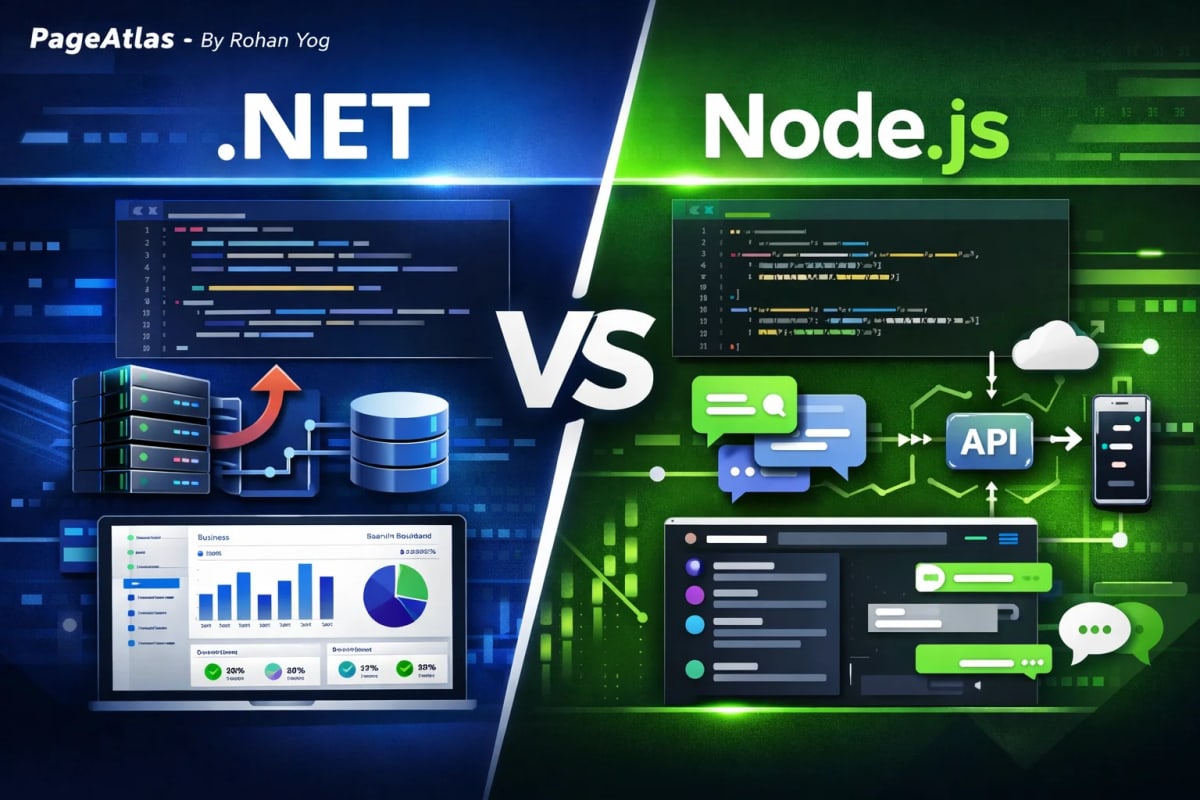
.NET vs Node.js: Which One Should You Actually Choose in 2026?
Introduction
Choosing the right backend technology directly impacts your application's performance, scalability, and long-term maintainability.
When comparing .NET vs Node.js, most developers focus on popularity or trends. However, the correct approach is to evaluate which technology aligns with your specific use case, team expertise, and product goals.
Both .NET and Node.js are powerful and widely adopted, but they are optimized for different types of workloads.
What is .NET?
.NET is a development platform by Microsoft, primarily used with C# to build web applications, APIs, and enterprise-grade systems.
It is known for:
- Strong architecture and structure
- High performance in complex applications
- Excellent tooling and ecosystem
- Long-term maintainability
What is Node.js?
Node.js is a JavaScript runtime that enables server-side development using JavaScript.
It is widely used for:
- Real-time applications
- APIs and microservices
- Fast MVP development
Key strengths include:
- Non-blocking, event-driven architecture
- High concurrency handling
- Unified language across frontend and backend
Key Difference Between .NET and Node.js
The core difference lies in how both technologies handle execution and workloads.
.NET vs Node.js
- Architecture.NET: Multi-threaded, structured execution
- Node.js: Single-threaded, event-driven non-blocking model
- Language.NET: C# (strongly typed)
- Node.js: JavaScript (dynamically typed)
- Performance Focus.NET: Optimized for CPU-intensive tasks
- Node.js: Optimized for I/O-intensive tasks
- Concurrency Handling.NET: Uses multiple threads
- Node.js: Uses event loop with async handling
- Scalability.NET: Scales well for complex enterprise systems
- Node.js: Scales efficiently for high concurrent connections
- Development Speed.NET: More structured, slightly slower initial development
- Node.js: Faster development, especially for MVPs
- Best Use Cases.NET: Enterprise apps, ERP systems, complex APIs
- Node.js: Real-time apps, chat systems, streaming services
- Learning Curve.NET: Moderate, requires understanding of C# and architecture
- Node.js: Easier for JavaScript developers
When to Choose .NET
Choose .NET in the following scenarios:
- Building enterprise-grade applications
- Developing systems with complex business logic
- Creating financial, healthcare, or administrative platforms
- Managing large and scalable codebases
- Prioritizing long-term maintainability and structure
.NET is typically preferred when stability, performance, and architecture are critical.
When to Choose Node.js
Choose Node.js when:
- Building real-time applications such as chat or live dashboards
- Developing lightweight APIs
- Creating MVPs or startup products
- Working with JavaScript-based teams
- Prioritizing speed of development
Node.js is ideal when fast iteration and handling concurrent users are key requirements.
Performance and Scalability
Performance should always be evaluated based on workload type.
- .NET performs exceptionally well in CPU-intensive and structured backend operations
- Node.js performs best in I/O-heavy scenarios with many concurrent connections
Scalability also depends on architecture:
- Node.js scales efficiently for real-time and concurrent systems
- .NET scales effectively for complex and large enterprise applications
Real-World Use Cases
- SaaS Admin Dashboard
- Best choice: .NET due to structured logic and maintainability
- Live Chat Application
- Best choice: Node.js due to real-time communication
- Enterprise ERP System
- Best choice: .NET for handling complex workflows
- Startup MVP
- Best choice: Node.js for rapid development
Step-by-Step Decision Guide
- Evaluate your team’s expertise
- Identify whether your app is real-time or logic-heavy
- Consider long-term scalability needs
- Check ecosystem compatibility
- Prioritize maintainability over short-term speed
Common Mistakes
- Choosing based on trends instead of requirements
- Ignoring team skill set
- Relying too much on micro-benchmarks
- Not planning for long-term scalability
Final Recommendation
- Choose .NET for enterprise, complex, and structured systems
- Choose Node.js for real-time, fast development, and high concurrency
Conclusion
The comparison of .NET vs Node.js is not about identifying a universal winner. It is about selecting the right tool for the right problem.
.NET provides strong architecture and performance for complex systems, while Node.js offers flexibility and speed for real-time applications.
The correct decision depends on your application requirements, team expertise, and long-term goals.
FAQ
Is .NET better than Node.js?
It depends on the use case. .NET is better for enterprise systems, while Node.js is better for real-time applications.
Is Node.js faster than .NET?
Not always. .NET can outperform Node.js in CPU-heavy tasks, while Node.js excels in handling concurrent requests.
Which is easier to learn?
Node.js is easier for JavaScript developers, while .NET is structured and suitable for those learning C#.
Which is better for startups?
Node.js is often preferred for rapid development, but .NET is suitable for complex startup applications.

Rohan Yog
Rohan Yog is a software developer and digital creator focused on building practical solutions and sharing knowledge about AI, blogging, and online income. Through PageAtlas, he helps beginners learn modern tools and turn their skills into real-world results.
View all articles by Rohan Yog→