Listen to this article
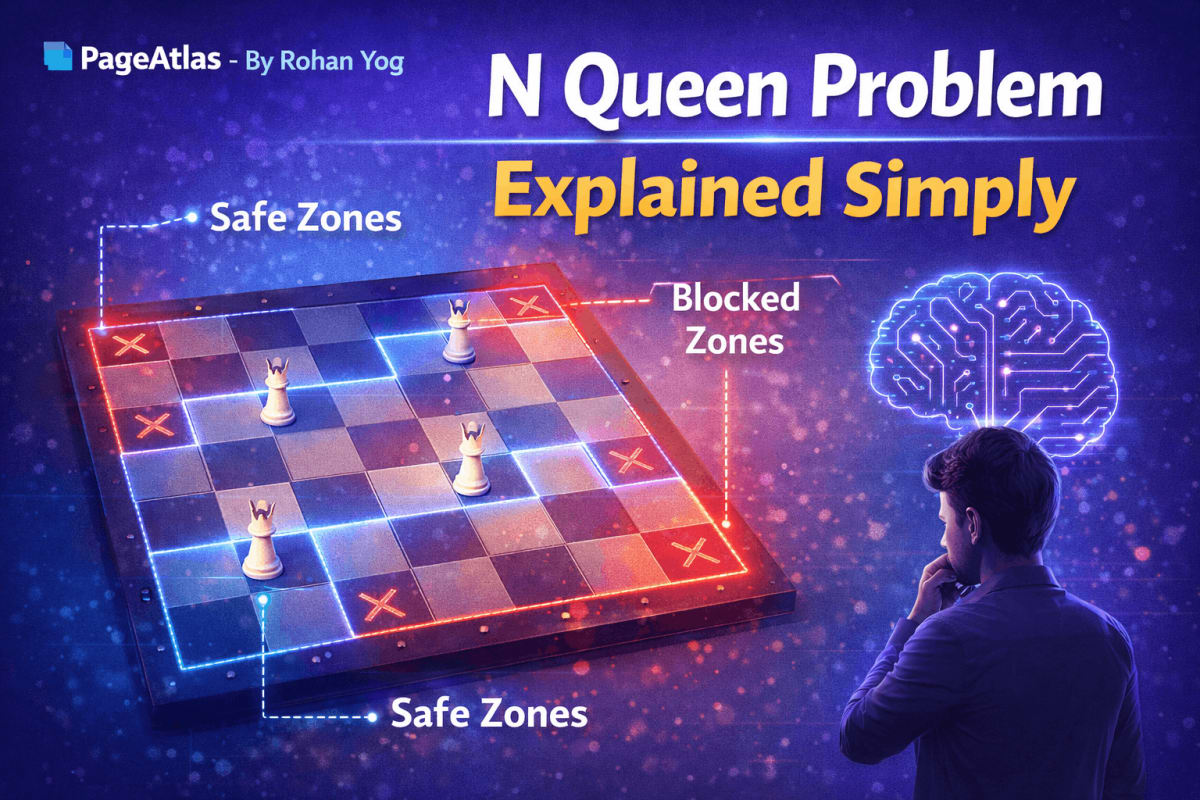
N Queen Problem Explained Simply (Step-by-Step + Easy Logic)
If you’ve ever looked at the N Queen problem and felt completely lost, you’re not alone.
At first glance, it looks confusing, complex, and full of tricky logic. But once you understand the core idea, it becomes one of the most satisfying problems in DSA.
In this guide, you’ll finally understand N Queen in the simplest way possible.
What is the N Queen Problem?
The N Queen problem is a classic problem where:
You are given an N × N chessboard.
Your goal:
Place N queens on the board such that no two queens attack each other.

How Does a Queen Attack?
A queen can attack in:
- Same row
- Same column
- Diagonals
So your placement must ensure:
- No two queens share the same row
- No two queens share the same column
- No two queens are on the same diagonal
Simple Example (4 Queens)
Let’s understand with N = 4.
We need to place 4 queens on a 4×4 board.
Valid solution looks like this:
. Q . .
. . . Q
Q . . .
. . Q .
Each row has one queen
Each column has one queen
No diagonal conflicts
Why is This Problem Important?
This is not just a random puzzle.
It teaches:
- Backtracking (very important in interviews)
- Recursion thinking
- Constraint handling
It’s also asked in:
- Coding interviews
- Competitive programming
Core Idea (Understand This Clearly)
We place queens one row at a time.
For each row:
- Try placing a queen in every column
- Check if it is safe
- If safe → move to next row
- If not → try another column
If stuck:
Backtrack and change previous placement
Step-by-Step Solution
Let’s break it down into very simple steps.
Step 1: Start with Row 0
Try placing queen in:
- Column 0
- Column 1
- Column 2
- Column 3
Step 2: Check if Position is Safe
Before placing, check:
- Same column conflict
- Left diagonal conflict
- Right diagonal conflict
Step 3: Move to Next Row
If safe:
Place queen and move to next row
Step 4: Backtracking
If no position works:
- Go back to previous row
- Move queen to next column
Step 5: Repeat Until Solution Found
Once all queens are placed:
You found a valid solution
Visual Thinking (Very Important)
Think like this:
You are exploring a tree:
- Each row = level
- Each column = choice
You try all possibilities, but only keep valid ones.
Code (C++ Simple Version)
bool isSafe(vector<string>& board, int row, int col, int n) {
    for(int i = 0; i < row; i++)
        if(board[i][col] == 'Q')
            return false;

    for(int i = row-1, j = col-1; i >= 0 && j >= 0; i--, j--)
        if(board[i][j] == 'Q')
            return false;

    for(int i = row-1, j = col+1; i >= 0 && j < n; i--, j++)
        if(board[i][j] == 'Q')
            return false;

    return true;
}

void solve(int row, vector<string>& board, int n) {
    if(row == n) {
        // print solution
        return;
    }

    for(int col = 0; col < n; col++) {
        if(isSafe(board, row, col, n)) {
            board[row][col] = 'Q';
            solve(row + 1, board, n);
            board[row][col] = '.';
        }
    }
}
Real-Life Analogy (Makes It Easy)
Imagine:
- Each row is a person
- Each column is a seat
You must seat everyone such that:
- No one conflicts with others
If conflict happens:
You change seating (backtracking)
Pro Tips (To Master N Queen)
1. Always Think Row by Row
Never try random placements.
2. Optimize Checking
Use arrays to track:
- Columns
- Diagonals
3. Practice Smaller Inputs
Start with:
- N = 4
- N = 5
4. Understand Backtracking Pattern
This pattern is used in:
- Sudoku
- Permutations
- Combinations
Common Mistakes
Mistake 1: Not Understanding Diagonals
Most beginners ignore diagonal checks.
Mistake 2: Forgetting Backtracking
You must undo the move.
Mistake 3: Wrong Index Handling
Diagonal logic often causes errors.
Mistake 4: Trying Brute Force Without Pruning
This makes solution very slow.
Time Complexity
Worst case:
O(N!)
But with pruning, it becomes efficient enough for typical constraints.
Advanced Optimization (For Interviews)
Use:
- Hash arrays for columns
- Left diagonal array
- Right diagonal array
This reduces checking time to O(1)
Why This Problem Feels Hard (But Isn’t)
It feels hard because:
- Too many possibilities
- Requires recursive thinking
But in reality:
It’s just:
Try → Check → Move → Backtrack
Final Thoughts
The N Queen problem is one of the best problems to understand backtracking deeply.
Once you master this, many other problems become easier.
FAQ
Q1: Is N Queen problem important for interviews?
Yes, it is a standard backtracking problem frequently asked.
Q2: What algorithm is used in N Queen?
Backtracking with recursion.
Q3: Why is N Queen difficult?
Because it involves multiple constraints and recursion.
Q4: What is time complexity?
Approximately O(N!).
Q5: How to master N Queen?
Practice backtracking problems regularly.

Rohan Yog
Rohan Yog is a software developer and digital creator focused on building practical solutions and sharing knowledge about AI, blogging, and online income. Through PageAtlas, he helps beginners learn modern tools and turn their skills into real-world results.
View all articles by Rohan Yog→