AI Will Replace Jobs by 2030?

Listen to this article
AI Will Replace Jobs by 2030? A Realistic, No-Hype Guide to Staying Relevant in the Age of Automation
Introduction: The Fear Everyone Is Talking About
Everywhere you look, there’s one conversation dominating headlines, social media, and workplace discussions:
“Will AI take my job?”
It’s not just a trend anymore. It’s a real concern.
With tools like ChatGPT, automation software, and AI-driven systems becoming more advanced, many professionals are starting to feel uncertain about their future. Some are excited. Others are anxious. Most are confused.
But here’s the truth:
AI is not here to destroy your career. It’s here to transform it.
The people who understand this shift early will thrive. Those who ignore it will struggle.
This article is not fear-based hype. It’s a clear, practical, and realistic guide to what’s actually happening — and what you should do next.
What Is Really Happening With AI Right Now?
Artificial Intelligence is evolving at an unprecedented speed.
A few years ago, AI could barely write a paragraph. Today, it can:
- Generate full-length articles
- Write and debug code
- Analyze large datasets
- Automate workflows
- Create images, videos, and voice content
And this is just the beginning.
Companies are adopting AI not because it’s trendy, but because it:
- Reduces operational costs
- Increases efficiency
- Scales faster than human teams
This shift is already visible across industries.
The Truth: AI Won’t Replace Jobs — It Will Replace Tasks
One of the biggest misconceptions is that AI will eliminate entire jobs overnight.
That’s not how disruption works.
Instead, AI replaces specific tasks within jobs.
For example:
- A content writer → AI helps draft faster
- A developer → AI assists in coding
- A marketer → AI automates campaigns
So the real transformation is:
Jobs are evolving, not disappearing.
However, there is a catch.
If your job consists mostly of repetitive, predictable tasks, then yes — your role is at high risk.
Jobs That Are Most Vulnerable
Let’s be honest and practical.
Some roles are more exposed to automation than others.
High-Risk Roles:
- Data entry operators
- Basic customer support agents
- Junior content writers (copy-paste type work)
- Manual QA testers
- Basic bookkeeping and accounting
These roles rely heavily on repetition, rules, and predictable workflows — exactly what AI excels at.
Jobs That Are Safer (For Now)
On the other hand, some roles are far more resilient.
Low-Risk Roles:
- Software engineers (especially problem-solving roles)
- Product managers
- Designers (creative + strategic)
- Entrepreneurs
- Skilled communicators and leaders
These roles involve:
- Creativity
- Decision-making
- Human interaction
- Strategic thinking
Areas where AI still has limitations.
The Real Competitive Advantage in 2026 and Beyond
The biggest shift is not AI vs humans.
It’s:
Humans + AI vs Humans without AI
This is where the real competition lies.
Someone who knows how to use AI effectively can:
- Work faster
- Produce better results
- Handle more workload
- Deliver higher value
And that person will outperform others — even if they have similar experience.
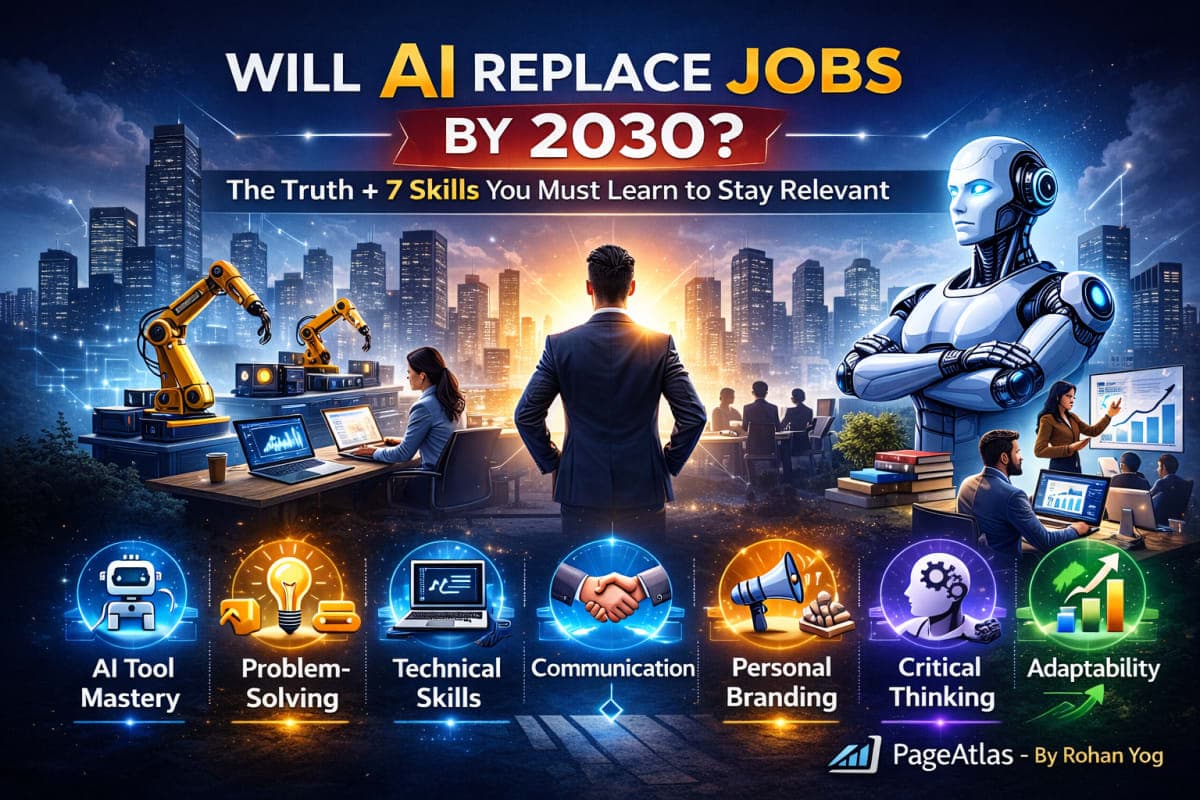
7 Future-Proof Skills You Must Start Learning Today
This is the most important section of this article.
If you focus on these skills, you won’t just survive — you’ll grow.
1. AI Tool Mastery
Understanding AI tools is no longer optional.
You don’t need to build AI models. You just need to use them effectively.
Examples:
- ChatGPT for content and coding
- Midjourney for design
- Automation tools like Zapier
Think of AI as your assistant.
The better you use it, the more powerful you become.
2. Problem-Solving Ability
AI can generate answers, but it doesn’t truly understand problems like humans do.
Companies don’t pay for answers.
They pay for solutions.
Improve your ability to:
- Break down problems
- Think logically
- Make decisions
This skill alone can make you irreplaceable.
3. Technical Awareness (Not Just Coding)
You don’t need to be an expert developer.
But you should understand:
- How systems work
- Basic programming concepts
- How APIs and integrations function
This helps you work better with AI and modern tools.
4. Communication Skills
Clear communication is becoming more valuable than ever.
Why?
Because:
- AI generates information
- Humans interpret and communicate it
Whether it’s writing, speaking, or presenting — this skill multiplies your value.
5. Personal Branding
In the AI era, visibility matters.
People trust individuals, not just resumes.
Start building your presence:
- Write blogs
- Share insights on LinkedIn
- Create content
This creates opportunities that skills alone cannot.
6. Critical Thinking
AI is not always correct.
Blindly trusting it can be dangerous.
You must:
- Verify outputs
- Analyze results
- Improve suggestions
This is what separates professionals from beginners.
7. Adaptability
This is the ultimate skill.
Technology will keep changing.
The only constant is change itself.
If you can adapt quickly, you will always stay relevant.
A Simple Action Plan You Can Start Today
Let’s make this practical.
You don’t need a 6-month plan. Just start small.
Week 1:
- Learn one AI tool (e.g., ChatGPT deeply)
Week 2:
- Build one small project using it
Week 3:
- Write one blog or LinkedIn post
Week 4:
- Share and get feedback
Repeat this cycle.
Consistency beats everything.
The Biggest Mistake People Are Making Right Now
Most people are doing one of two things:
- Ignoring AI completely
- Overhyping it without learning it
Both are wrong.
The right approach is:
Understand → Experiment → Apply → Improve
The Future of Work Is Already Here
The next few years will create a massive gap:
- Those who adapt early
- Those who resist change
This gap will define careers, income, and opportunities.
The question is not:
“Will AI replace jobs?”
The real question is:
“Are you evolving fast enough to stay ahead?”
Final Thoughts
AI is not your enemy.
It’s your leverage.
If you use it wisely, it can:
- Multiply your productivity
- Expand your opportunities
- Future-proof your career
But if you ignore it, it will replace the way you work.
Call to Action
If this article gave you clarity:
- Start learning one AI tool today
- Share this with someone who needs it
- Bookmark this guide for your growth
Because the future is not waiting.
And neither should you.

Rohan Yog
Experienced writer and tech enthusiast. Follow for more insightful articles on technology, programming, and web development.
View all articles by Rohan Yog→