
Listen to this article
TCP/IP Explained Simply (With Real-Life Example That Finally Makes Sense)
Every time you open a website, send a message, or watch a video, something powerful is working behind the scenes.
That “something” is TCP/IP.
Most tutorials make it sound complicated. But in reality, it’s just a smart way computers communicate.
Let’s break it down so clearly that you never forget it again.
What is TCP/IP?
TCP/IP is a set of rules that allows computers to communicate over the internet.
Think of it like a communication system.
- TCP → Ensures data is delivered correctly
- IP → Ensures data reaches the correct destination
Together, they make the internet work.

Simple Real-Life Example (Best Way to Understand)
Imagine sending a parcel to your friend.
Here’s what happens:
- You write the address → This is like IP
- You pack items safely → This is like TCP
- Courier delivers it → Internet
If something is missing or damaged:
- TCP ensures it is resent
This is exactly how data travels online.
Why Do We Need TCP/IP?
Without TCP/IP:
- Computers wouldn’t understand each other
- Data could get lost or corrupted
- Internet wouldn’t function
It solves three major problems:
- Where to send data
- How to send data
- How to ensure it arrives correctly
How TCP/IP Works (Step-by-Step)
Let’s understand what happens when you open a website.
Step 1: You Enter a URL
Example: google.com
Your system needs to find its IP address.
Step 2: DNS Resolves IP
Domain → IP address
Example: google.com → 142.x.x.x
Step 3: Data is Broken into Packets
Large data is divided into small packets.
Each packet contains:
- Data
- Source address
- Destination address
Step 4: TCP Adds Reliability
TCP ensures:
- Packets are sent in order
- Missing packets are resent
- No duplication
Step 5: IP Routes Packets
IP decides:
- Best path to reach destination
Packets may take different routes.
Step 6: Data Reassembled
At destination:
- TCP reorders packets
- Combines them into original data
TCP vs IP (Simple Difference)
TCP:
- Handles reliability
- Ensures correct delivery
IP:
- Handles addressing
- Ensures correct destination
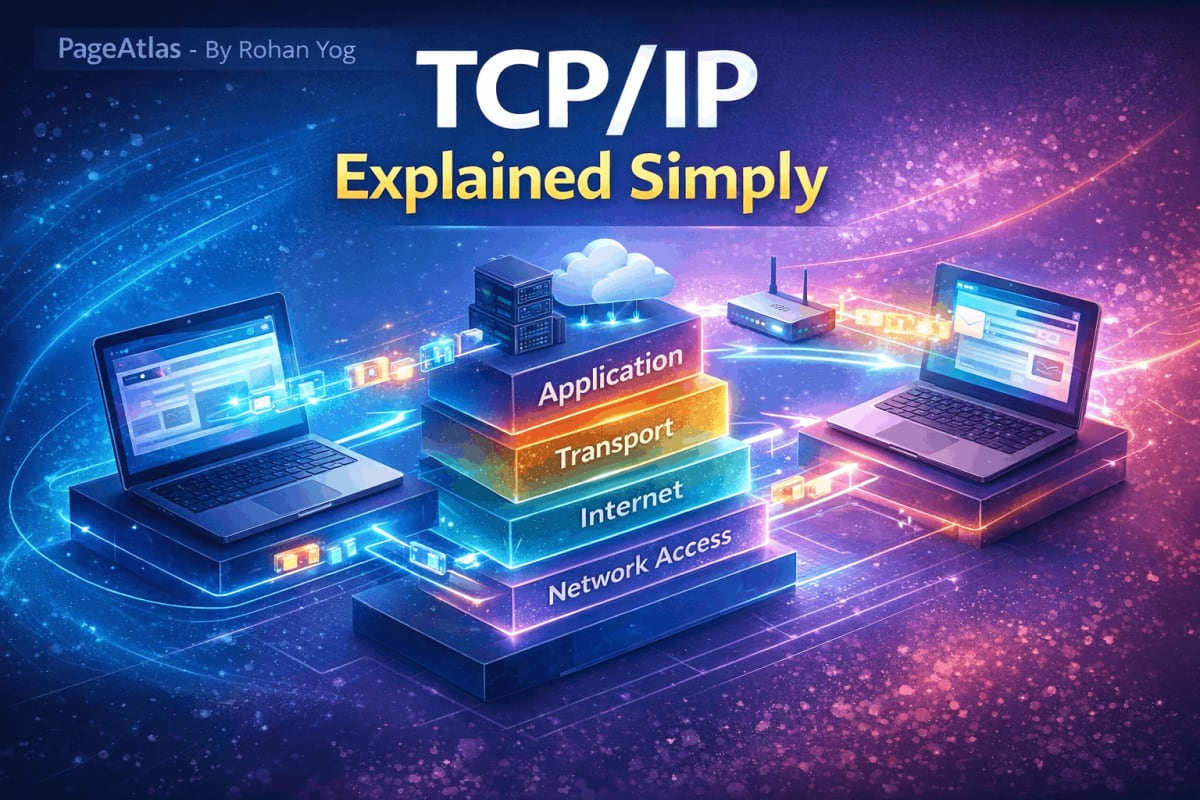
TCP/IP Layers Explained Simply
The TCP/IP model has 4 layers.
Application Layer
This is what users interact with.
Examples:
- HTTP (web browsing)
- FTP (file transfer)
Transport Layer
Handled by TCP/UDP.
Responsibilities:
- Data delivery
- Error checking
Internet Layer
Handled by IP.
Responsibilities:
- Routing
- Addressing
Network Access Layer
Handles:
- Physical transmission
- Hardware communication
Easy Way to Remember Layers
Think like sending a message:
- Application → Write message
- Transport → Pack message
- Internet → Choose route
- Network → Send physically
TCP vs UDP (Important for Interviews)
TCP:
- Reliable
- Slower
- Used in websites
UDP:
- Fast
- No guarantee
- Used in streaming
Real-World Applications
TCP/IP is used everywhere:
- Browsing websites
- Sending emails
- Video streaming
- Online gaming
Pro Tips (Very Important)
1. Always Think in Layers
Each layer has a specific role.
2. Remember TCP = Reliability
That’s the key concept.
3. Practice with Real Examples
Think:
“What happens when I open YouTube?”
4. Learn Differences Clearly
- TCP vs UDP
- OSI vs TCP/IP
Common Mistakes
Mistake 1: Thinking TCP and IP are Same
They have completely different roles.
Mistake 2: Ignoring Layers
Understanding layers is critical.
Mistake 3: Memorizing Without Understanding
Always relate to real-life examples.
Mistake 4: Confusing OSI Model
TCP/IP is simpler than OSI.
Why This Topic is Important
- Frequently asked in interviews
- Core networking concept
- Essential for developers
Advanced Insight (To Stand Out)
If you want deeper understanding:
- Learn packet structure
- Understand ports
- Explore HTTP over TCP
Final Thoughts
TCP/IP is not complicated.
It’s just a system that ensures:
- Data reaches the right place
- Data arrives correctly
Once you understand this, networking becomes much easier.
FAQ
Q1: What is TCP/IP in simple words?
It is a communication system that allows computers to exchange data over the internet.
Q2: What is difference between TCP and IP?
TCP ensures reliability, IP handles addressing.
Q3: Is TCP/IP important for interviews?
Yes, it is a fundamental networking concept.
Q4: How many layers are in TCP/IP?
There are 4 layers.
Q5: Where is TCP/IP used?
It is used in all internet communication.

Rohan Yog
Rohan Yog is a software developer and digital creator focused on building practical solutions and sharing knowledge about AI, blogging, and online income. Through PageAtlas, he helps beginners learn modern tools and turn their skills into real-world results.
View all articles by Rohan Yog→