Gemini 4 Argon: What Google's AI Can Do With Your Hardest Problems

Listen to this article
Gemini 4 Argon: What Google's AI Can Do With Your Hardest Problems
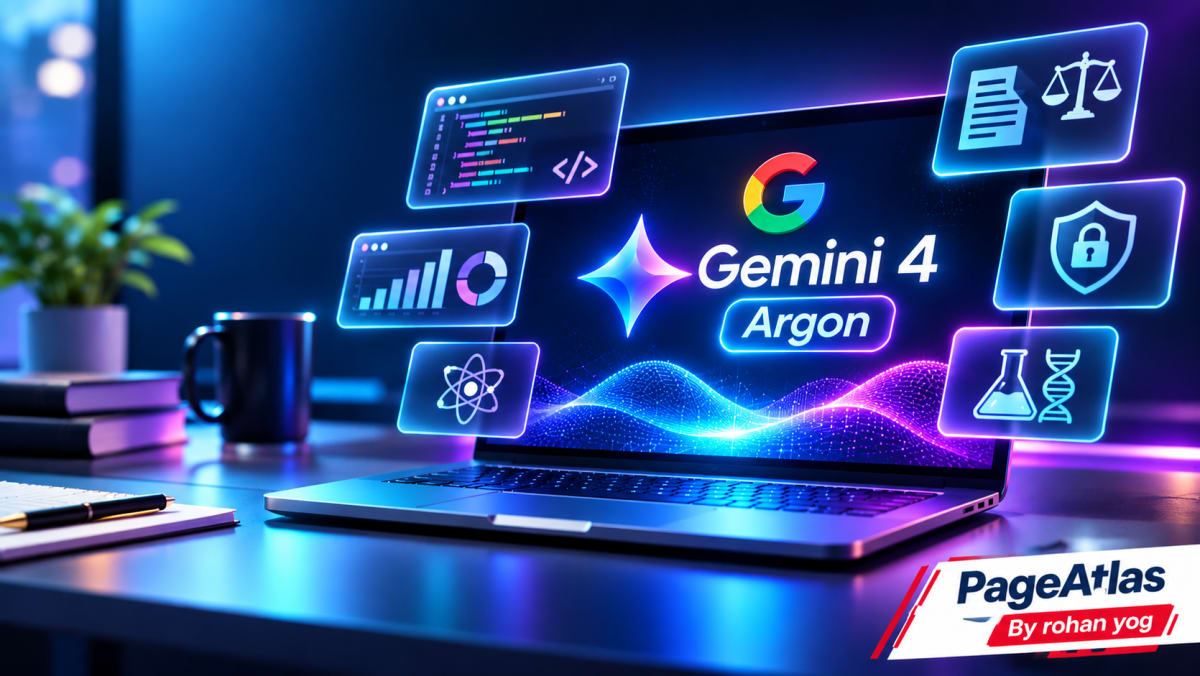
Google's Gemini 4 Argon is designed for problems that need more than a quick answer. It focuses on complex software engineering, financial and legal work, scientific research, cybersecurity, and tasks that require an AI model to reason through multiple steps. Its biggest selling point is a unified context window of up to 1 million tokens, giving it room to work with large amounts of information in a single task.
But here's the more interesting question: does a model built for difficult work actually change how developers, researchers, and businesses get things done? The answer depends less on the announcement and more on how you use it.
Quick Answer: What Is Gemini 4 Argon?
Gemini 4 Argon is Google's advanced reasoning model, built to handle demanding, multi-step tasks across coding, research, finance, legal work, science, and cybersecurity. It supports a unified context window of up to 1 million tokens and is available through Google's Gemini products and developer platforms, subject to plan and access requirements.
Why Google Built Gemini 4 Argon for Difficult Tasks
Most people use AI for short jobs: explaining a concept, rewriting an email, generating a small code snippet, or summarising a document. Those tasks are useful, but they don't test the limits of an AI model.
Real professional work is messier.
Imagine asking an AI to investigate a bug that appears only in one part of a large application. It may need to understand several files, follow dependencies, inspect logs, identify the likely cause, suggest a fix, and check whether that fix could break something else.
A quick response isn't enough. The model needs to maintain context and work through the problem carefully.
That's the kind of workload Google says Gemini 4 Argon is designed to handle. Its focus is on long-running tasks where the model needs to reason across a large amount of information rather than simply respond to one isolated question.
In my view, this is a more meaningful direction for AI development than simply making chat responses sound more natural. Professionals need systems that can help complete difficult work, not just produce convincing explanations.
The 1 Million Token Context Window: Why It Matters
One of the headline features of Gemini 4 Argon is its unified context window of up to 1,048,576 tokens.
In simple terms, a context window is the amount of information a model can work with during a task. That information can include your instructions, source code, documents, and the model's responses.
Why should you care?
Think about a developer working on a large .NET application. The issue might involve an API controller, a service, an Entity Framework query, authentication middleware, and a database configuration. Looking at only one file may not reveal the actual problem.
A larger context window can help the model consider more of that material together.
The same idea applies to other professions:
- A legal team can provide lengthy documents for analysis.
- A financial analyst can work with large collections of reports and supporting information.
- A researcher can examine multiple papers and datasets within one workflow.
- A software team can investigate dependencies across a substantial codebase.
However, a 1-million-token context window doesn't mean the model will understand every detail perfectly. More context can help, but irrelevant information, conflicting instructions, and poor-quality documents can still affect the result. You should also verify important conclusions.
Google's developer documentation describes the 1-million-token limit as a unified input-and-output window, rather than a separate allowance for input alone.
What Gemini 4 Argon Can Do in Real-World Work
Google highlights several areas where Argon is intended to help. Here's what those capabilities mean in practical terms.
1. Software Engineering and Large Codebases
This is probably one of the most interesting areas for developers.
A coding assistant that generates a function is useful. But a model that can investigate a complicated codebase, understand dependencies, propose architectural changes, and help with large migrations has a different role.
Google says Argon has been used for large-scale code migrations, including work moving C and C++ codebases toward Rust. The company also describes its use in optimizing existing software and handling complex engineering tasks.
For a typical developer, useful tasks could include:
- Investigating bugs that involve multiple files.
- Reviewing a proposed refactoring.
- Understanding unfamiliar code before modifying it.
- Finding possible performance bottlenecks.
- Planning a migration from an older architecture.
- Writing and reviewing automated tests.
For example, suppose you're maintaining an ASP.NET Core Web API with authentication, business services, and database operations. Instead of asking the model to fix one error message, you could provide the relevant service, controller, configuration, logs, and expected behaviour.
Ask it to trace the request flow, identify possible causes, and suggest a fix with tests.
That is a much better use of a reasoning-focused model.
Still, don't give an AI unrestricted control over production code. Review its changes, run your tests, and check security-sensitive modifications yourself.
2. Finance and Legal Work
Financial and legal tasks often involve lengthy documents, detailed rules, and information that needs to be checked across multiple sources.
Gemini 4 Argon is designed to assist with work such as financial research, document analysis, and legal drafting. Google positions it as a model for complex enterprise knowledge work, rather than only everyday question answering.
For example, a finance team might use an AI model to compare reports, identify differences between financial documents, or prepare an initial research summary.
A legal professional might use it to organise contract clauses, identify areas that need review, or prepare a first draft.
But there's a boundary here. An AI-generated legal interpretation isn't a substitute for a qualified lawyer, and financial analysis still needs human verification. A model can miss an exception or misunderstand a document's context.
Use it to reduce research and drafting time, not to remove professional responsibility.
3. Cybersecurity and Vulnerability Research
Cybersecurity is another area where a model's ability to reason through complex tasks matters.
Finding a vulnerability can require examining code, understanding how different components interact, and working out whether a particular input could create a security problem.
Google says Argon has been developed with cybersecurity defence in mind and has been used in workflows involving vulnerability identification and patching. Its initial September announcement also described a controlled access programme for trusted cyber defenders.
For security teams, AI assistance could be useful when reviewing code, explaining suspicious behaviour, organising vulnerability reports, and preparing remediation suggestions.
The important distinction is between helping defenders understand and fix security problems and blindly trusting an AI-generated patch. Every proposed change still needs testing and security review.
4. Science and Mathematical Research
Scientific work can involve lengthy reasoning, complex equations, large datasets, and repeated experiments.
Google says Argon is intended to support scientific and mathematical problem-solving, including work in areas such as quantum computing and life sciences. The company has also described internal research applications involving quantum algorithm optimisation.
For researchers, the potential value is straightforward: an AI model can help explore possible approaches, explain technical material, review calculations, and assist with research workflows.
But scientific accuracy cannot be judged by how confidently a model explains an answer. Results need to be checked against established methods, reproducible experiments, and reliable evidence.
Where Can You Use Gemini 4 Argon?
Gemini 4 Argon isn't limited to one interface. Google has made it available across several products, although the exact access depends on the product and subscription.
The main options include:
Gemini App
Google AI Pro and Ultra subscribers can access Argon through the Gemini app, according to Google's availability announcement. This is the more familiar option for people who want to use AI without writing code or configuring an API.
Google AI Studio and Gemini API
Developers can access the model through Google AI Studio and the Gemini API. The model ID is gemini-4-argon.
This is the route to consider if you're building an application, testing prompts, or integrating the model into an existing software product. Google's developer documentation also provides API examples and configuration details.
Google Antigravity
Google also lists Gemini 4 Argon in Google Antigravity for eligible Google AI Ultra subscribers. This is particularly relevant to developers who want to use AI as part of a coding and agent-based workflow.
Before choosing a platform, check the current plan requirements and regional availability. Access can differ between the consumer app, API, and developer tools.
Gemini 4 Argon Pricing: What Developers Should Know
Pricing matters, especially if you're planning to use a reasoning model for long tasks or integrate it into a product.
Google announced introductory API pricing of:
- Input tokens: $2 per 1 million tokens.
- Output tokens: $10 per 1 million tokens.
- Cached input tokens: 95% below the standard input-token price.
The introductory pricing is listed through November 30, 2026. Google's developer documentation says standard pricing after that period will be $4 per million input tokens and $20 per million output tokens.
Here's something developers should pay attention to: input and output costs are different. A workflow that sends large amounts of source code and generates lengthy responses can consume more tokens than a simple chat interaction.
Before using Argon in production, estimate the cost of a realistic task. Don't calculate your budget using only a short prompt and a one-paragraph response.
Also consider whether every task actually needs a high-end reasoning model. A smaller or less expensive model may be perfectly adequate for routine classification, simple summaries, and basic text generation.
Is Gemini 4 Argon Better Than Other AI Models?
This is where comparisons need some care.
Google has published benchmark results showing Argon's performance against other frontier models across coding, knowledge work, science, mathematics, and other categories. The results are useful, but they don't establish that Argon is the best model for every task.
A model can perform strongly on a coding benchmark and still struggle with a particular production application. Another model may be better suited to a specific writing, research, or automation workflow.
My recommendation is simple: compare models using the work you actually do.
If you're a developer, test the same real bug investigation or refactoring task across the models you're considering. Check the correctness of the code, the quality of the explanation, the number of corrections required, and the total cost.
If you're a researcher, compare how well each model handles your documents and whether its conclusions can be verified.
The best model isn't necessarily the one with the highest benchmark score. It's the one that gives you reliable results for your actual workload at a reasonable cost.
Common Mistakes to Avoid
Assuming a Larger Context Window Guarantees Better Answers
A million tokens sounds impressive, but adding every available file to a prompt isn't a good strategy. Include the relevant material and explain what you want the model to investigate.
Trusting Generated Code Without Testing It
Even advanced models can introduce bugs, misunderstand requirements, or suggest unsafe changes. Run automated tests, review the diff, and check security-sensitive code before merging anything.
Using an Expensive Model for Simple Tasks
You don't need a frontier reasoning model to rewrite a short email or explain a basic programming concept. Match the model to the complexity of the task.
Treating Benchmark Results as a Final Verdict
Benchmarks measure particular tasks under particular conditions. They don't guarantee that a model will perform equally well in your environment.
Sharing Sensitive Business Information Without Checking Policies
Before uploading source code, contracts, customer records, or internal reports, review the relevant data-handling terms and your organisation's security policies.
Frequently Asked Questions
What is Gemini 4 Argon?
Gemini 4 Argon is Google's advanced AI reasoning model, designed for complex tasks involving software engineering, finance, legal work, cybersecurity, science, and mathematics. It supports a unified context window of up to 1 million tokens and is available through Google's consumer and developer platforms, depending on access requirements.
Is Gemini 4 Argon available to everyone?
Google announced global availability on October 13, 2026, across selected consumer and developer products. However, access depends on the platform and subscription. Developers can use the Gemini API and AI Studio, while access through the Gemini app and Antigravity has specific Google AI plan requirements.
What is the context window of Gemini 4 Argon?
Gemini 4 Argon supports a unified context window of up to 1,048,576 tokens. This window covers input and output together, allowing the model to work with large amounts of information during a task. It doesn't guarantee perfect recall or accuracy across every document.
Can developers use Gemini 4 Argon for coding?
Yes. Developers can access it through the Gemini API and Google AI Studio. It is designed for complex software engineering tasks, including code analysis, multi-step problem-solving, and large codebase work. As with any AI coding tool, generated changes should be reviewed and tested before deployment.
How much does Gemini 4 Argon cost?
Google announced introductory API pricing of $2 per million input tokens and $10 per million output tokens through November 30, 2026. The announced standard rates after that date are $4 per million input tokens and $20 per million output tokens. Check Google's current pricing page before budgeting for production use.
The Real Test Is What You Build With It
Gemini 4 Argon is an interesting step toward AI systems that can help with longer, more demanding professional tasks. Its large context window, reasoning capabilities, and focus on engineering and research make it worth exploring, particularly if your work involves complex problems.
But don't choose it just because the announcement sounds impressive.
Take one real task from your work, give Argon the relevant context, and judge the result. Did it solve the problem correctly? Did it save time? Could you verify its work? Those answers will tell you far more than a benchmark headline.

Rohan Yog
Rohan Yog is a software developer and digital creator focused on building practical solutions and sharing knowledge about AI, blogging, and online income. Through PageAtlas, he helps beginners learn modern tools and turn their skills into real-world results.
View all articles by Rohan Yog→